The professional services automation market is projected to nearly double over the next five years, growing from just over fifteen billion dollars in 2025 to nearly twenty-nine billion by 2031.
That is not a technology trend, it is a signal that the way professional services organisations operate is fundamentally changing.
From the buyer's side in 2026, this is what it looks like:
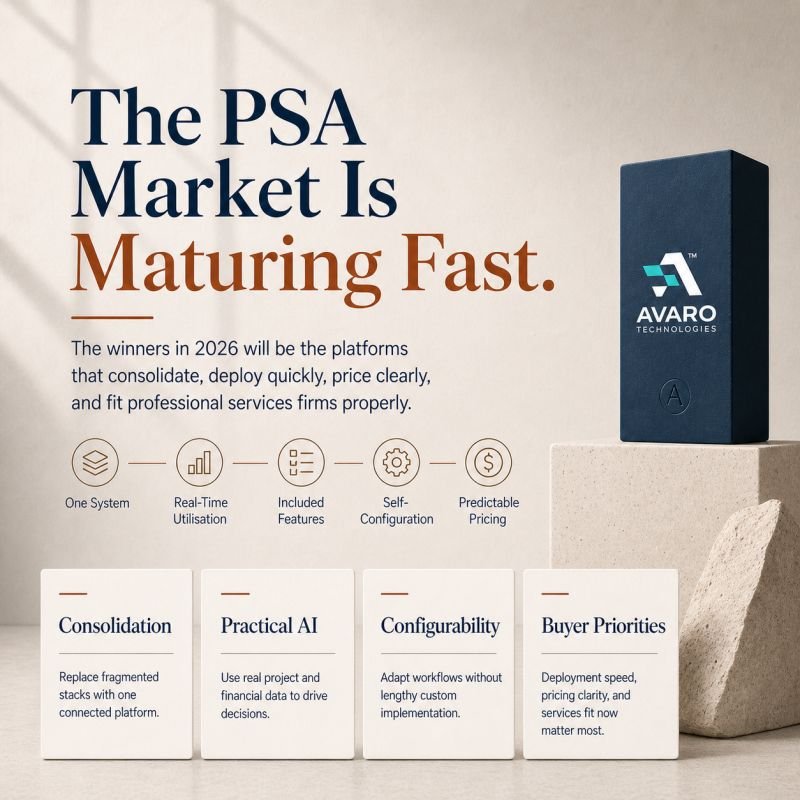
- The biggest shift is consolidation. Organisations that spent the last decade assembling a stack of five or six specialised tools; a CRM here, a project tool there, a time tracker, an invoicing system, a separate marketing platform... are now actively looking for a single platform that replaces all of them. The integration tax has become unsustainable. Many syncs break, every licence renewal is a negotiation, every new vendor adds a security review.
- The second shift is AI, though the reality is more measured than the marketing suggests. The genuinely useful AI applications in professional services software are not chatbots or generative content tools. They are predictive resource allocation, automated utilisation alerts and intelligent revenue forecasting. The question is not whether your platform has AI, as nearly every vendor claims it does, the question is whether its AI uses your actual project and financial data to determine insights that change how you operate.
- The third shift is configurability. Low-code and modular platforms are gaining ground because organisations no longer want to wait six months for a custom implementation, they want to configure workflows, approval chains, and reporting dashboards without writing code or hiring a consultant.
For any services organisation evaluating platforms in 2026, five questions cut through the noise.
- Does the platform cover sales and delivery in one system, or will you still need integrations?
- Is utilisation tracking built in and real time, or bolted on and delayed?
- Are features like e-signatures, marketing automation, and document tracking included, or are they paid add-ons?
- Can you configure the platform yourself, or do you need the vendor's professional services team?
- Does the pricing scale predictably with your headcount, or does it jump at arbitrary thresholds?
The market is maturing rapidly. Feature parity between vendors is narrowing, which means the differentiators are shifting from what a platform can do to how quickly it deploys, how transparently it is priced, and how well it serves the specific needs of professional services firms rather than trying to be all things to all industries.
Firms that choose well now will carry a structural advantage for the next five years. Those that delay will spend those years paying the integration tax.
Avaro One | Integrated CRM + PSA Platform
#AvaroOne | #ProfessionalServices | #Operations | #fragmentation | #CRM_PSA