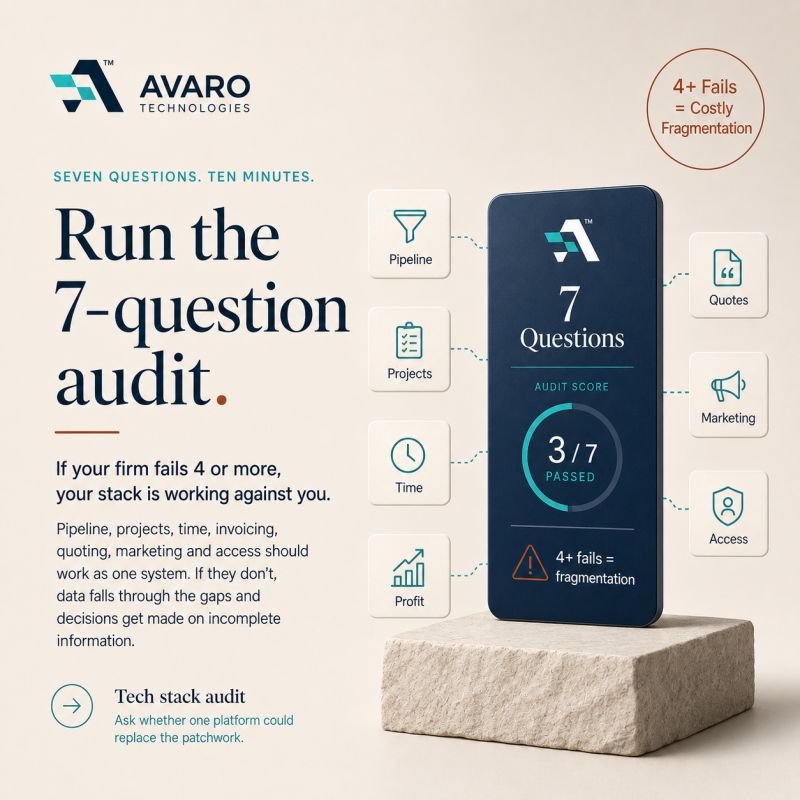
You can audit any consulting organisation's tech stack in under ten minutes.
- Seven questions - Yes or No answers.
- Many organisations fail at least four of them.
Here are the seven.
𝗢𝗻𝗲: can you see your pipeline, active projects, and utilisation on a single screen without opening a spreadsheet? If the answer is no, your tools are not talking to each other and every management decision relies on stale data.
𝗧𝘄𝗼: when a deal closes, does a project automatically appear in your delivery system with the right scope, budget, and team assigned? If someone has to manually create the project in a separate tool, you are losing time and introducing errors at the most critical handoff in your business.
𝗧𝗵𝗿𝗲𝗲: can a consultant log time against a project and have it instantly update the project budget, the client invoice draft, and the utilisation dashboard? If time tracking lives in a different system from invoicing, you are paying for reconciliation every month.
𝗙𝗼𝘂𝗿: do you know, right now, which of your active projects are profitable and which are not? Not at month end. Not after a spreadsheet exercise. Right now. If the answer is no, you are flying blind on the metric that determines whether your firm makes money.
𝗙𝗶𝘃𝗲: can you send a quote with e-signature, track when the client opens it, and convert it to a project without re-entering data? If quoting, e-signatures, and project creation live in three different tools, your sales-to-delivery cycle is slower than it needs to be.
𝗦𝗶𝘅: does your marketing — email campaigns, lead scoring, and nurture sequences — use the same contact database as your CRM and project system? If marketing runs on a separate platform, your leads exist in two places and your attribution is unreliable.
𝗦𝗲𝘃𝗲𝗻: can a new starter access every system they need with a single login and a single set of permissions? If onboarding requires setting up accounts in four or five different tools with separate credentials, your security surface is wider than it should be and your admin overhead is multiplied.
Count your failures. Each one represents a gap where data falls through, time is wasted, or decisions are made on incomplete information. One or two failures might be tolerable. Four or more means your tech stack is actively working against you.
The fix is not to add another integration or another tool. It is to ask whether a single platform could replace the patchwork entirely. Run the audit, be honest about the score. That number is the clearest measure of what fragmentation is costing your firm.
Find out more about Avaro-One™ here : Avaro One | Integrated CRM + PSA Platform
Register for a free Avaro-One™ account : Avaro-One
#AvaroOne | #ProfessionalServices | #PSA | #CRM | #SaaS